Weyerhaeuser Pembina 2027 Forest Management Plan
The Weyerhaeuser Pembina 2027 Forest Management Plan (FMP) is currently being developed. The plan’s key objective is to maintain current harvest levels in Forest Management Unit (FMU) R15 while applying sustainable, ecologically-based forest management practices that balance timber production with other forest values.
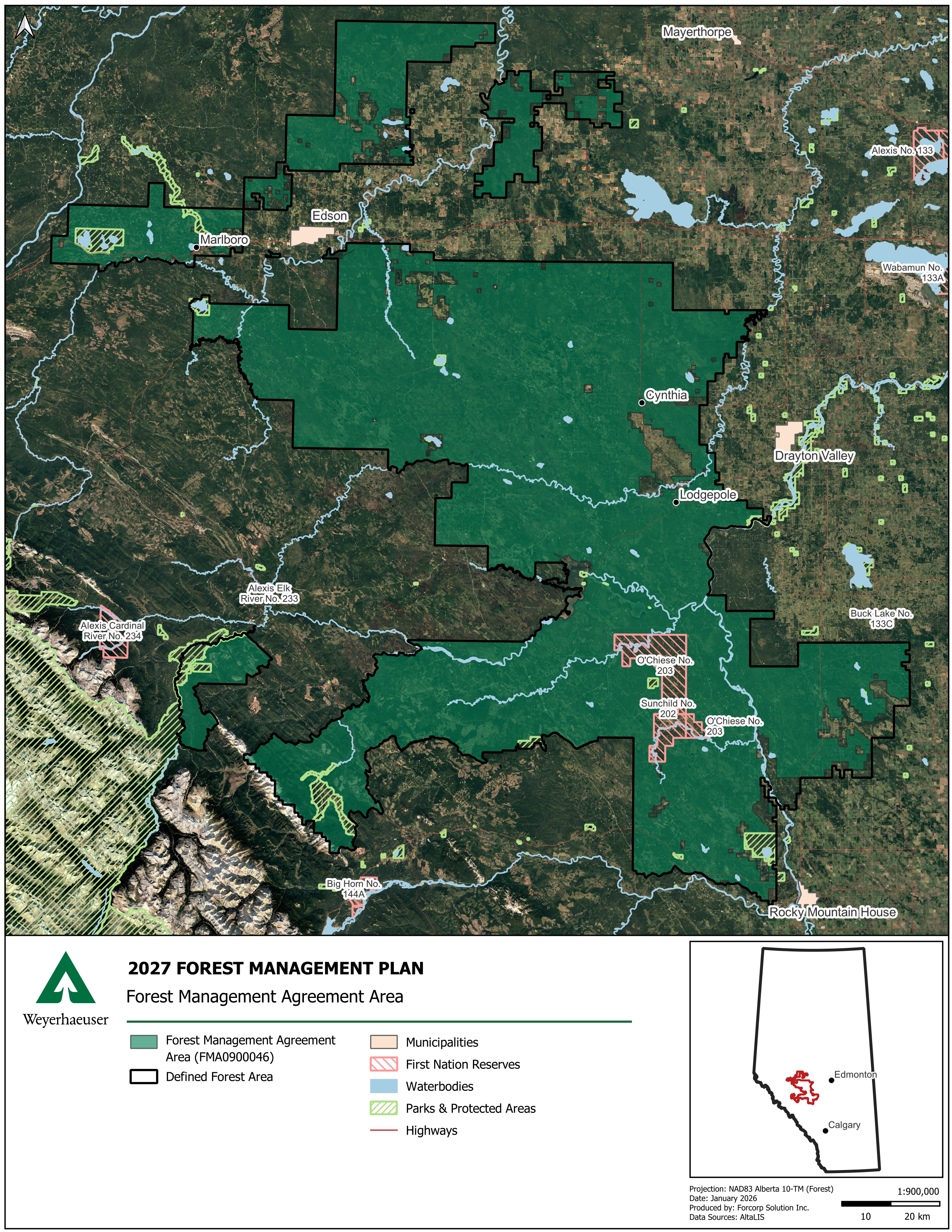
The 2027 FMP will cover Forest Management Area (FMA) 0900046 and includes the FMA and non-FMA portions of FMU R15, collectively known as the Defined Forest Area (DFA). Once approved by the GoA, the Weyerhaeuser Pembina 2027 FMP will direct forest management activities in FMU R15 for the next 10 years.
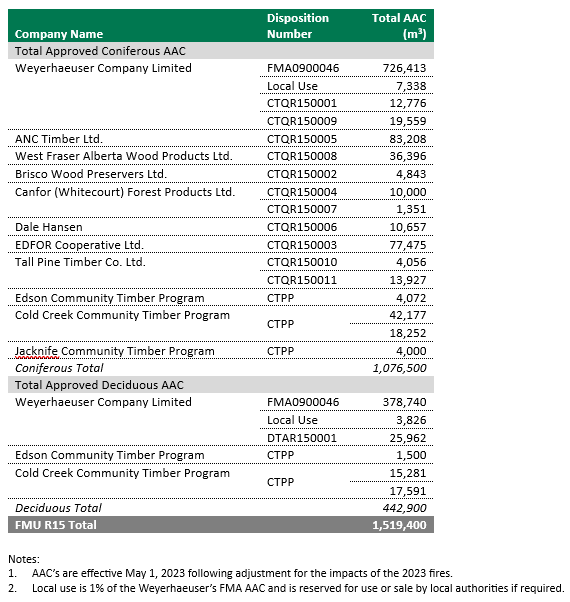
The current timber allocations and Annual Allowable Cut (AAC) can be found in the table below.
FMP Development Timelines
The development of a Forest Management Plan (FMP) is a multi-year process involving industry, government, technical consultants, First Nations, Métis Settlements, and Credibly Asserted Metis Communities, and public stakeholders. Key components of the final plan include Values, Objectives, Indicators, and Targets (VOITs), the net landbase (NLB), growth & yield, the Preferred Forest Management Scenario (PFMS), and the Spatial Harvest Sequence (SHS). Indigenous consultation and stakeholder engagement are ongoing throughout FMP development.

VOITs
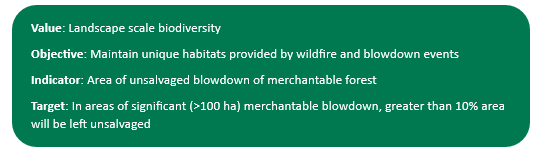
Values, Objectives, Indicators, and Targets (VOITs) are a key component of forest management planning. VOITs ensure that forest values are being maintained on the landscape and provide the performance standards that are to be met through on-the-ground forest management activities. Forest Management Plans (FMPs) must include, at a minimum, 32 standard VOITs set by the Government of Alberta. Every VOIT identifies a priority value, defines a clear objective, outlines an indicator used to measure progress, and specifies a target to be achieved. These values address a broad range of considerations, including biological diversity, ecosystem productivity, soil and water resources, benefits to society, and sustainable development.
Monitoring and forest stewardship reporting are important components of the FMP. Forestry companies must report on their VOITs at both the five-year and ten-year milestones of the approved FMP. Stewardship reporting is a mandatory process comparing planned and actual performance with the intent of achieving objectives and targets as identified in the approved plan. Monitoring provides the necessary feedback on assumptions and predictions and supports adaptive management. Through the monitoring program, data is collected to verify the status of the forest and based on this information, management of forest resources will continue as prescribed or be modified to achieve the strategies and commitments made in the FMP.
Weyerhaeuser Pembina’s 2016 Stewardship ReportNet Landbase
The net landbase (NLB) identifies the portion of the forest that is both productive and suitable for timber harvest. The development of an accurate and representative NLB is a key component in determining a sustainable Annual Allowable Cut (AAC) for the Defined Forest Area (DFA). The NLB incorporates the necessary spatial data layers and administrative boundaries used for analysis and harvest planning.
Much of the land in a company's Forest Management Agreement (FMA) area is not eligible or suitable for timber harvest. Some examples of these non-harvestable areas include First Nations reserves and Métis Settlements, parks and protected areas, non-treed land (e.g., wetlands, grasslands), and non-merchantable stands (e.g., forested areas that are too wet or too steep). These areas are removed and the remaining area is defined as the net landbase. The NLB is the area on which the companies focus their forest management activities.
Growth and Yield
Growth and yield refers to the measurement and monitoring of tree growth over time. It is used to estimate the volume of timber currently available for harvest and to project how the forest will grow in the future. This information supports the determination of a sustainable harvest level over the long term, ensuring that companies do not remove more wood than the forest can regenerate within a defined period of time.
Companies are required to maintain a growth and yield monitoring program to confirm that managed stands are meeting or exceeding projected growth rates. Across their Forest Management Agreement (FMA) area, companies collect data from a network of sampling plots to monitor long-term growth trends and for use in future timber supply analysis. These field measurements are incorporated into forest growth models to statistically estimate forest volume and future yield.
Preferred Forest Management Scenario
The Preferred Forest Management Scenario (PFMS) establishes a long-term harvesting strategy that balances the environmental, economic, and social values of the forest. Using spatial timber supply modelling, computer models evaluate outcomes from different management activities and identify what to harvest, when to harvest it, and where harvesting should occur across the Defined Forest Area (DFA). The result of this process is a PFMS that outlines the timber harvesting schedule and regeneration activities for the next 20 years, projects the long-term sustainable harvest level, and evaluates potential impacts on other forest values over a 200-year planning horizon. This long-term outlook ensures sustainability of both timber supply and non-timber forest values such as old forest, wildlife habitat, and watershed function.
Although planning extends 200 years into the future, the PFMS only determines the specific harvest locations and volumes for the first 20 years of the plan. At the end of this period, a new Forest Management Plan (FMP) and PFMS are developed, reflecting updated data, monitoring results, and a commitment to continual improvement. This cyclical planning process includes ongoing evaluation and adjustment to ensure implementation aligns with projected outcomes.
Spatial Harvest Sequence
One of the key outputs of the Preferred Forest Management Scenario is the Spatial Harvest Sequence (SHS). The SHS identifies the location of forest stands scheduled for harvest within the Defined Forest Area (DFA) over the next 20 years.
Indigenous Consultation & Stakeholder Engagement
Indigenous consultation and stakeholder engagement is a multi-year process that takes place alongside the development of the Forest Management Plan (FMP). Input gathered through consultation and engagement helps inform key components of the FMP, such as harvest sequencing and access planning. This ongoing dialogue supports transparency, strengthens relationships, and helps ensure forest management reflects a broad range of social, cultural, environmental, and economic interests over the lifetime of the plan.
Information on upcoming public engagement opportunities